


01
Configure your SKU scheme once
Define the attributes your SKUs encode, category, gender, condition, destination market, sequential ID, custom fields. Set the format and order. The configuration applies to every new item across the operation.

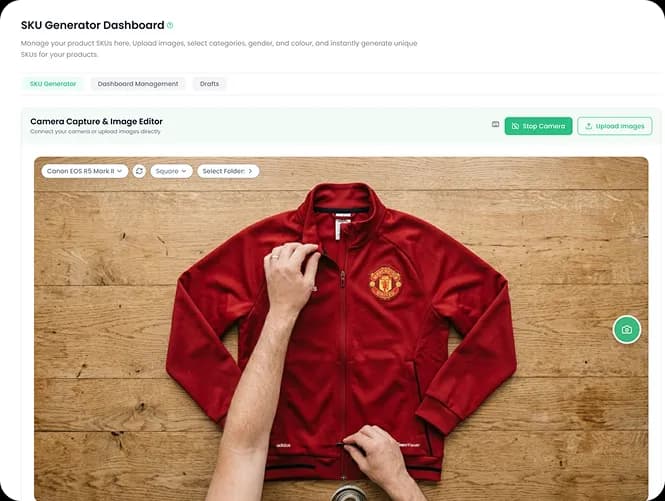
Connect your cameras directly to Thriftify. Generate a unique SKU and barcode for each item. Imagery is saved directly in Thriftify. Listing operators achieve the highest possible listing speeds.

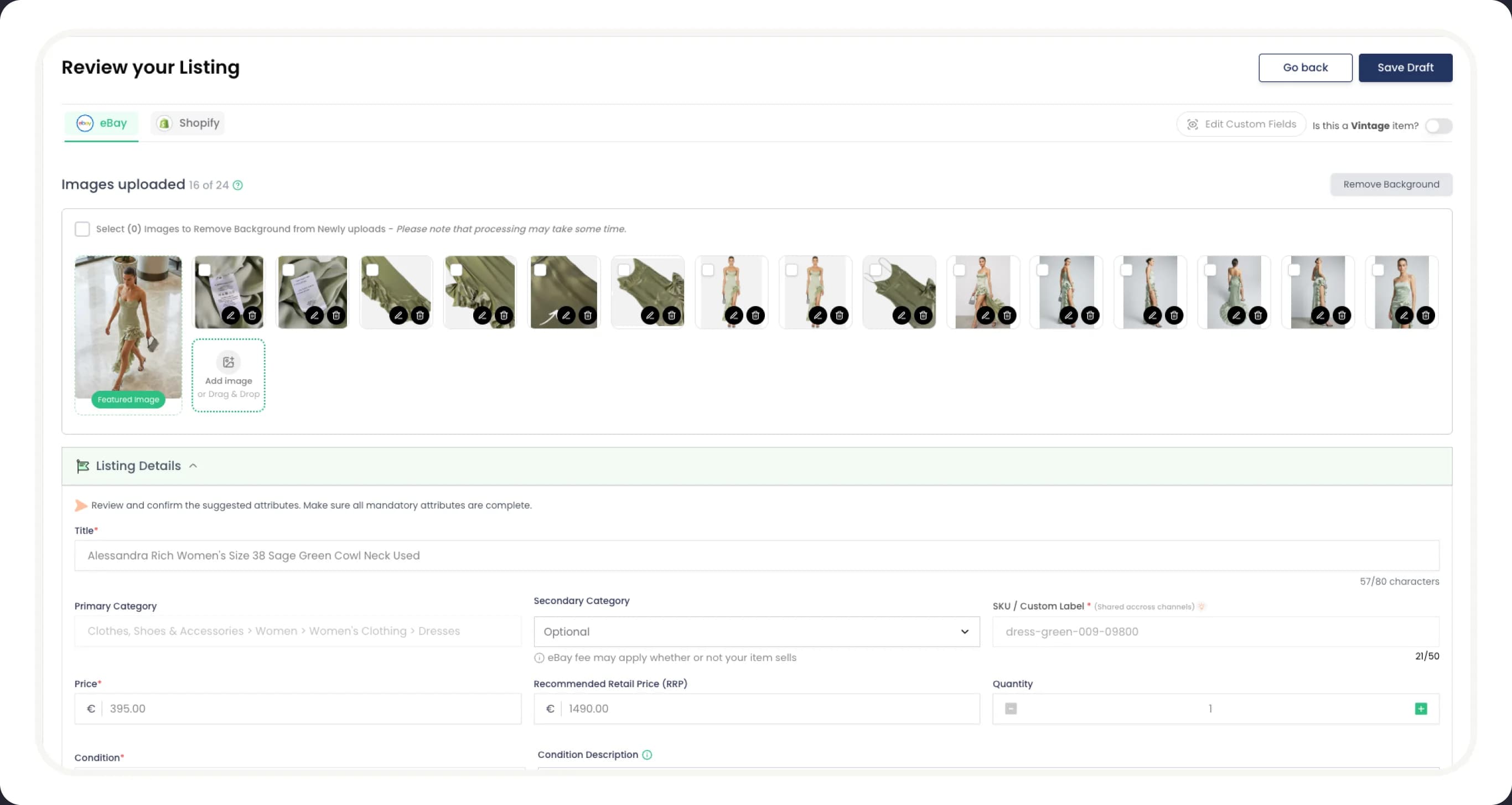
Thriftify creates a unique SKU at intake, encoded with custom attributes you choose. The SKU becomes the single linking key across eBay, Shopify, photography, reporting and your WMS, EPOS and PIM; so every item's live state is one click away.
SKU management isn't glamorous, but it's the spine of every resale operation that runs at scale. Here's what production looks like.
Our largest users track items across countries and dozens of statuses. Real operations, real inventory, real-time visibility.
SKU is the linking key. Thriftify, eBay, Shopify, WMS, PIM, EPOS, Reporting. Every system points to the same record.
Photographed, pending, in-transit, arrived, on-shelf, pricing review, listed, sold, fulfilled. Fully customisable stages.
Configure attribute order, format, sequencing. Match existing systems, reporting and pick & pack workflows.
Our largest users track items across countries and dozens of statuses. Real operations, real inventory, real-time visibility.
SKU is the linking key. Thriftify, eBay, Shopify, WMS, PIM, EPOS, Reporting. Every system points to the same record.
Photographed, pending, in-transit, arrived, on-shelf, pricing review, listed, sold, fulfilled. Fully customisable stages.
Configure attribute order, format, sequencing. Match existing systems, reporting and pick & pack workflows.
Four steps from intake to inventory truth. The SKU follows the item through each system.
Define the attributes your SKUs encode, category, gender, condition, destination market, sequential ID, custom fields. Set the format and order. The configuration applies to every new item across the operation.
Either via Thriftify's interface or via API push from your intake system. Thriftify generates the SKU automatically using, your scheme, prints on a barcode label, attaches to the item, and travels with it through the operation. SKUs are generated along with photography, saving time.
When the item is photographed, the SKU links the photos to the listing. When the listing publishes, the SKU links to the marketplace listing IDs. When the item sells, the SKU links to the fulfilment record. One key unifies all your systems and reporting.
Thriftify shows every item by workflow stage, with filtering by category, channel, location, age, or any other attribute. HQ visibility across multi-shop operations. API access for integration into BI or warehouse management systems.
Live photography view, image management and editing, SKU generation and barcode printing.
Three examples of how customer operations benefit from having a proper SKU system in place.
VC-WO-CL-VG-DE-RUZB2MWO-CS-EX-GB-RUZB2MOX-DUB-CL-GD-2026-04812The SKU scheme is configured once and applies to every new item. Operations with multi-shop or multi-region structures can encode location and market into the SKU itself, which makes downstream filtering and reporting easy. Operations with simpler structures keep schemes shorter. The dashboard supports any approach your business needs.
Most listing tools generate SKUs as an afterthought, random strings, no encoded meaning, no dashboard, no truth source across systems. Three operational consequences of that shortcut.
Without a single linking key, your eBay listing IDs, your Shopify products, your warehouse stock, and your accounting records diverge over time. Reconciling at end-of-quarter is a manual project. SKU truth makes the reconciliation automatic, every system points to the same key.
Without dashboard visibility on SKU age, you don't notice inventory that's been sitting for 90 days. Using relist date rather than original SKU intake date is one of the most common pricing mistakes, it masks stagnation. Thriftify tracks original SKU age, so aged inventory is flagged before it becomes a problem.
Two locations is manageable manually. Fifty locations isn't. The SKU dashboard's location filter, paired with multi-shop role-based access, lets HQ see consolidated state across the estate without asking each shop to export a spreadsheet.
The SKU isn't a standalone feature, it's the spine that connects AI listing, cross-listing, pricing rules, and the API.
Every AI-generated listing carries the SKU from intake. The listing on all channels references the SKU; the dashboard tracks the listing performance back to the SKU. The link is automatic, no manual data entry.
The SKU is the inventory truth across multiple-regions and channels. When the item sells on any channel, the SKU's state updates in real time and the de-list propagates within 5 seconds across all other channels.
Pricing rules (including Strike Through Pricing) target SKUs by age, items that have been live for 29 days, 60 days, 90 days. Without the SKU age tracking, this isn't possible. With it, pricing automation is precise.
Every API operation, create, update, mark sold, push status, uses the SKU as the reference key. Integration with WMS, ERP, or PIM systems happens at the SKU layer. Push-based status updates from authorised partners use the SKU to identify the affected item. Enabling automation at scale.
SKU truth scales with operational complexity. Each segment uses it slightly differently.
Aged-inventory flagging and category tracking across seasonal stock turnover. Help picking teams to easily find orders.
See vintage in detailSKU linkage between POS, Thriftify, and online channels, single inventory truth across in-store and online. Track consignee codes.
See consignment in detailMulti-shop SKU schemes with location encoded. HQ visibility across the entire estate. Make complex reporting automated.
See charity retail in detailAPI-driven SKU sync between WMS and Thriftify. Used by large organisations to power comprehensive operational automation.
See enterprise in detailYour first 500 listings are free. No credit card required. Connect your existing eBay or Shopify account and Thriftify will generate SKUs for your inventory using a default scheme, customise the scheme once you've seen how the dashboard works.
Listing 500+ items a week? Book an enterprise call